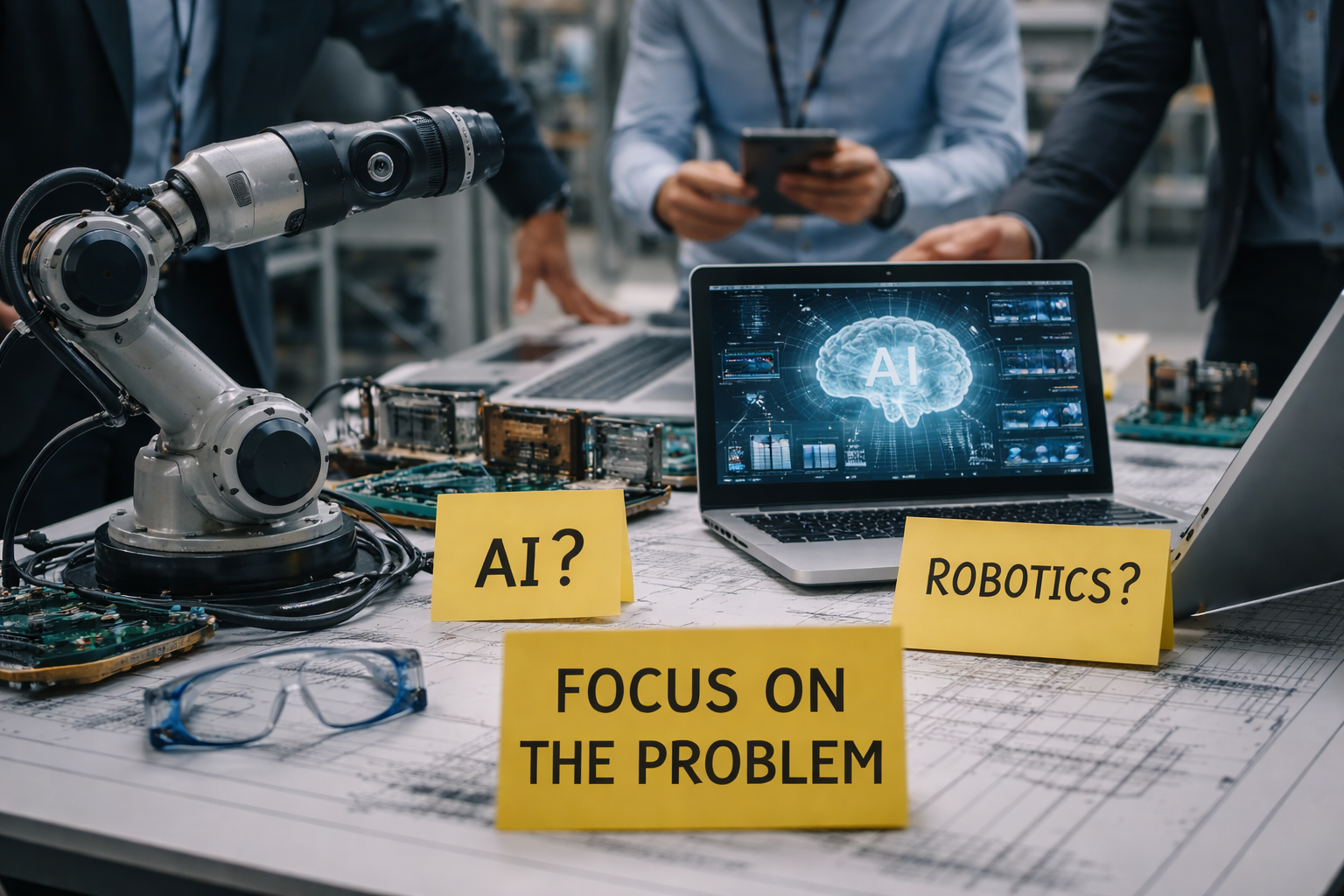
When the Technology Becomes the Strategy
Walk into almost any automation planning meeting today and you'll hear the same words:
- AI.
- Machine vision.
- Robotics.
- Digital twins.
These technologies are powerful — and in the right application, they can completely transform a manufacturing process.
But there's a trap.
Too often, manufacturers begin with the technology instead of the problem.
Instead of asking: "What is the simplest system that solves our bottleneck?"
The conversation becomes: "Where can we apply robotics or AI?"
That shift in thinking can add enormous complexity to what should have been a straightforward solution.
Most Automation Problems Are Mechanical First
In many cases, the real bottleneck isn't advanced technology at all.
It's:
- Inconsistent product presentation
- Poorly designed upstream processes
- Unstable material flow
- Packaging variability
When those issues aren't solved first, no amount of machine learning or vision systems will fix the problem.
In fact, advanced technologies often magnify instability rather than solve it.
The most successful automation projects start with process discipline, not algorithms.
The Seduction of "Smart" Solutions
Technology vendors often highlight the most exciting capabilities:
- AI-powered inspection
- Fully autonomous robotic cells
- Adaptive vision systems
And these tools absolutely have their place.
But the question shouldn't be: "What is the smartest system we can build?"
The better question is: "What is the most reliable system we can build?"
In manufacturing, reliability beats novelty every time. A simple, robust solution that runs 98% uptime will outperform a cutting-edge system that constantly needs adjustment.
Technology Should Follow Architecture
The best automation strategies follow a clear sequence:
- Stabilize the process
- Simplify the flow
- Build repeatable mechanical systems
- Add controls and data
- Apply advanced technology where it adds real value
When AI, robotics, and advanced sensing are layered on top of a strong foundation, they become powerful tools rather than fragile experiments.
The Next Tech Philosophy
At Next Tech, we love advanced technology.
But we also know when not to use it.
Our approach focuses on:
- Mechanical simplicity
- Stable product handling
- Modular architecture
- Strategic use of robotics and vision
Because the goal isn't to build the most impressive system.
The goal is to build the system that runs every day.
Automation should simplify operations — not complicate them.